
History
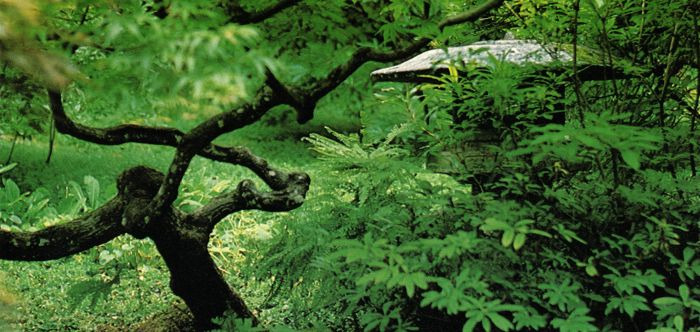
In addition to Gravelly Lake, the cluster of lakes, known as the lakes district, on the tree-sprinkled prairies south of Tacoma that includes American, Steilacoom, Spanaway and Tule, is still one of the loveliest areas in the Pacific Northwest.
Before the first white explorers came upon them, the lakes were familiar to the Indians, but not as dwelling places. The Puyallup and Nisqually Indians of this region made their villages on the shores of rivers and Puget Sound, where fish, clams and oysters were plentiful and waterborne travel easy. The Indian villages nearest the lakes were Steilacoom, Clover Creek and nearby Spanaway. The Indians knew all the lakes well, but visited them only during deer or duck hunting expeditions. We can imagine what impressed them most about Gravelly Lake, because of their name for it—"Cook-al-chy" which meant "Pond Lily".
The silence of Indian lore on the subject of the lakes, however, was in contrast to the enthusiastic praises recorded by the early white explorers. Theodore Winthrop's "Canoe and Saddle" gives a vivid account of his trip from Fort Nisqually to the Cascades in 1853. In the Lakes District, then as now, each fresh sight of Mt. Tacoma (or Mt. Rainier, as it is now known) brought new delight, even for those who have lived in the shadow of "The Mountain" for years. Sometime between Winthrop's journey and 1891 the lake was renamed Gravelly Lake. Settlers had discovered that it lay in a vast gravel basin, topped by a thin layer of silt. When the silt was disturbed, water disappeared into the gravel and the level of the lake mysteriously fell. As the lake had no visible inflow or outflow, this puzzled Indians and whites alike.
Gravelly Lake is about 160 feet deep. The differences between the high and the low levels sometimes reaches twelve feet. The lake usually is highest at about June 1 and lowest in October and November. The level is believed to be under the influence of the vast underground flow of water through the bed of gravel that lies between the melting snows of Mount Rainier and the Sound, though its conduct at times is not in consonance with that theory. In recognition of the grave’s role in the lake's peculiar behavior, the settlers named it Gravelly. Its fluctuating level may still be observed today.
By 1890s Tacoma was well established as a town on the shores of Commencement Bay, and promoters were creating potential suburbs to the south and west. One of these was a town named Winthrop which lay between Lake Steilacoom and Gravelly Lake, with a mile of waterfront along the eastern shore of the latter, named for that same Theodore Winthrop who had passed through 40 years before.
This embryo suburb was glowingly described in Spike's "Pictorial History of Tacoma," 1891, as:
nestled near the shores of Gravelly Lake, one of those romantic 'lochlets' with which the southwestern environs of Tacoma abounds ... in the midst of the famed "natural park region', only eight miles from the (Tacoma) harbor and center of business ... yet removed from all bustle or annoyance ... It has a special suburban climate, superior to that of the city and sound shores, notably in winter, having more sunshine, less fog and no mud." (A reference to the sad state of the unpaved streets in downtown Tacoma.) "The passing spectator here sees masses of trees, shrub, vine, flower and fern growths, entwined in loving embrace and wild abandon.
One wonders who could resist. It appears, however, that many did, because Winthrop never really became a thriving community. Similar enticements must have played a part in the transaction that resulted in the sale, 20 years later, of the property that was to become Villa Carman. The Interlaaken tract, which ran along the north and west shores of Gravelly Lake, was offered for sale by the Tacoma Land and Improvement Company in 1910. The two largest and choicest Interlaaken lots, at the lake's northeast corner, were initially purchased by Mr. and Mrs. William G. Pearce of Massachusetts, probably as an investment, as they never came to inspect their property. When they resold it in 1919, the virgin evergreen forest was still intact all the way from Gravelly Lake Drive to the shores of the lake.
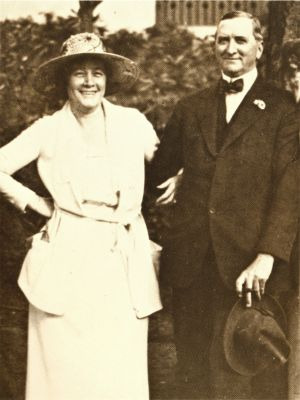 The new owners of this lovely lakeside preserve were Mr. and Mrs. Joseph Lincoln Carman, who for 20 years had been among the leaders of Tacoma's business and social world. Carman had come to Tacoma from Iowa in 1890 at the age of 29 with his friend and business associate R. E. Anderson where both were to make their fortunes, Anderson in real estate and investments and Carman in manufacturing. Carman Manufacturing Company, producing mattresses, is still thriving today and in 2003 was recognized as one of the only 37 of the 3600 businesses that incorporated in 1903 that have stayed in business for 100 years. In 1954 Carman Manufacturing adopted the Spring Air Northwest trade name, and in 1999 consolidated its four factory operations into one 135,000 square foot plant in Lacey after operating in the same 90,000 square foot wooden building on East 25* street for 110 years.
During the post-World War I era, Tacoma was still the "City of Destiny" and fortunes were being amassed in real estate, banking, shipping, lumber and manufacturing. The Carmans excelled during this era of "gracious living" along with many who would later be their neighbors in the Lakes District. Most of the city's social life had centered in the North End, with the fabled and magnificent Tacoma hotel as the focal point. Now, however, the Lakes District became increasingly more attractive with its promise of an expansive and elegant lifestyle which beckoned the Carmans as well as many other prominent citizens who longed to get away to the "country".
One attraction was the Tacoma Country and Golf Club, founded by Alexander Bailie in the early 1900s. In 1906 Joseph Carman was one of 25 men who contributed money to buy land on American Lake for the club and adjacent residential lots for members' summer homes. The Carmans, however, soon exchanged their lot, and located their summer home on Gravelly Lake. This was a two story "cottage" called Namrac Hall (their names spelled backwards).
Concurrently, the era of the imposing Lakes District estates got underway. Chester Thorne built Thornewood on American Lake in 1912 - a sprawling, old English, 40 room, 18 bath mansion. Its gardens were designed by the famed Olmsted landscape architects of Boston, who also did the J.P. Weyerhaeusers' Haddaway Hall overlooking Commencement Bay in 1923. The Carmans created Villa Carman in 1920-21, the first year-round residence of stature on Gravelly Lake. Kirtland Cutter of Spokane was selected as the architect. He also designed Thornewood and was for over 30 years the Northwest's leading architect.
In summary, the words of historian W.P. Bonney describe Josepha Carman as "one of the most progressive and energetic men to have inaugurated large and important undertakings." Such an undertaking was the construction of a magnificent lakeside home.
Margaret Carman, who matched her husband in energy and ambition, applied herself to the task of planning the estate. She studied estates and gardens. Kirkland Cutter of Spokane was selected as the architect. Undoubtedly Margaret was influenced by Cutter's reputation of 30 years as the Northwest's leading architect. She also could not have been unaware that he had designed Thornewood.
Strongly influenced by southern Europe and Japan, she planned an Italianate villa surrounded by spacious gardens, including one in the Japanese style. The grounds received careful attention. The gardens were to include walks and winding flower-bordered paths, fountains, streams, flagged courtyards and dramatic vistas.
Mrs. Carman worked with Seattle landscape architect Fred Cole and together they created a beautifully proportioned formal Roman garden, with walks, native plantings, and contoured lawns sweeping down to the lake. For the Japanese garden, Mrs. Carman not only imported rocks and plants from Japan but also a gardener. The rocks were specially chosen for their symbolic shapes, and the pattern that they created was repeated in the pruning of nearby shrubs. A waterfall cascaded into a pool, shaded by Japanese maples, Ukon flowering cherries, pines and azaleas. She installed the centuries-old stone temple lanterns she and her husband had brought from Japan. Later, this garden was described as having both of the qualities most prized in a Japanese garden: "wabi" and "sabi"—that is, refinement and simplicity. Mrs. Carman had prolific gardens on the estate with masses of roses, delphiniums, snapdragons and larkspur. There was also a fruit or chard and raspberry patches. Over the years the gardens matured, increasing in beauty and renown. A signal honor was their inclusion in the July 1930 tour sponsored by the Garden Club of America.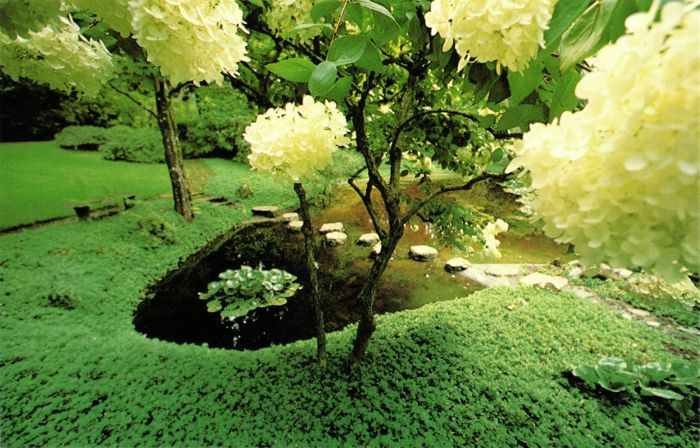
As noted previously, when Mr. Carman arrived in Tacoma, he was accompanied by his friend and business associate R.E. Anderson. Mr. Anderson also bought property along Gravelly Lake - later sold to Everett Griggs - then later it became the property of Corydon Wagner and is now Lakewold Gardens, a public estate.
The Lakes District became the showcase of Tacoma with stately homes and elegant parties. However, life on the lake was not all nightlife and parties; more typically it was an active, family-centered existence. In spite of being so far from metropolitan bustle. Lakes residents were close to everything they needed. To go to town, they had only to take the street car which ran along Gravelly Lake Drive. If they needed supplies, they could order them from the Lakeside Store at Interlaaken and Washington Boulevard, which would deliver them in an ancient but durable Model T truck. Even Roberts Grocery, at Division and J, regularly delivered to the Lakes District. When ice was required for a party, it could be fetched from nearby Ponders Corners.
The 20's were a golden era, but they drew to a close as a shadow fell over America - the Great Depression, which brought with it, for many, curtailment of the high living they had enjoyed for so long. A few years later, for Joseph and Margaret Carman, who had played such a center stage role in the flowering of Tacoma and the Lakes District society, time ran out. Margaret died in 1937 and Joseph in 1938. Their son and his second wife, Mary Lee, moved to the Villa, but Mary Lee neither wanted nor needed such a big house. With only one child the small family found that a 27-acre estate was more responsibility than they cared for: It took a staff of at least six to keep everything maintained, including three gardeners for Margaret's extensive gardens and lawns.
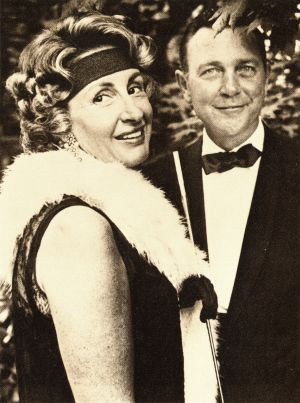 Villa Carman was sold to L.T. Murray in November, 1939, and a new chapter in the life of this legendary estate began. The Murrays had been longtime residents of the Tacoma area, having established the West Fork Timber Company. As their company prospered and their family grew, they began to look for a larger home. They liked the long drive into the Villa which began with the European-style gatehouse. The road passed under the giant fir tree that stretched a trunk-sized arm protectingly across the road, a tree that was a seedling 400 years before the villa was ever imagined.
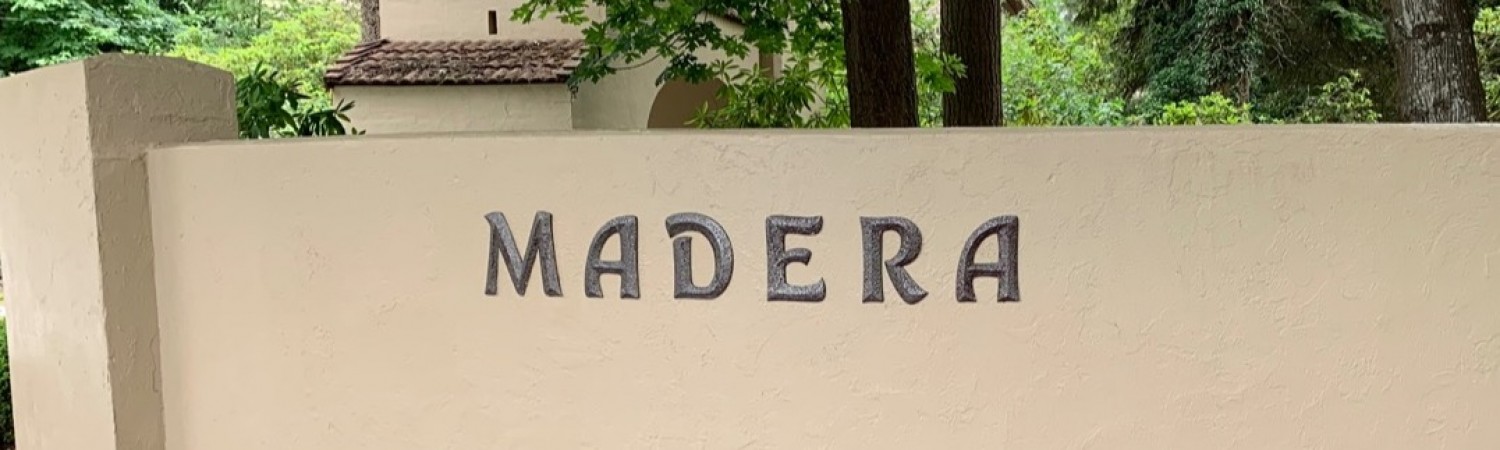
New ownership for the estate brought few real changes except in the name. Helen Murray had been intrigued by the name 'Madeira', used by Chrysler for its most luxurious cars in the late '30s. When she learned that 'Madera' meant 'wood' in Spanish, her mind was made up. The choice was an appropriate one, because of the estate's bountiful forests and also because L.T. Murray had made his fortune and reputation in the timber business.
Helen Murray faced up to the challenges of this 27-acre domain, which included 19 acres of gardens. She gamely set out to learn all she could, in addition to working alongside a skilled, fulltime gardener. In time she acquired the necessary knowledge to become a gifted horticulturist in her own right. Helen's intense interest in gardening never left her during the Murrays' 40 years of residence at Madera. She had the formal garden redesigned as a rose garden by landscape architect John Grant, author of several authoritative books on landscaping. The roses were planted in beds of different colors, and surrounded by borders of peonies, iris and phlox, carefully arranged so flowers would be blooming all summer. She was careful to preserve the magnificent azaleas and wild rhododendrons, and over the years she added many varieties of cultivated rhododendrons. She lovingly tended and perfected the Japanese garden with its wisteria-garlanded arbor and its teahouse at the pool's edge -since then, unfortunately, lost to vandals.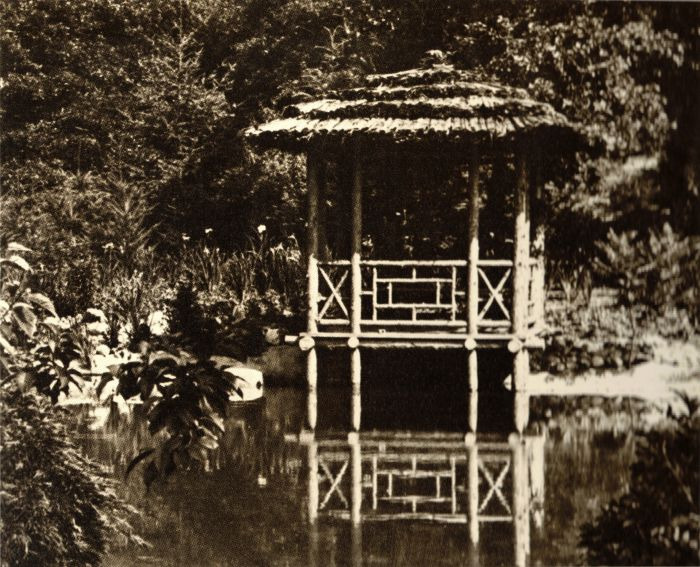
As the years passed, the fame of the Madera gardens spread far beyond the Pacific Northwest. Sunset Magazine published pictures and an article on the primrose path to the rose garden in 1961, describing how the plants were arranged by color: in succession, beds of white, cream, yellow, terracotta red, blue, lavender and pink. The Garden Club of America sponsored three additional Madera tours, in 1959, 1962, and 1977. The knowledgeable, and widely traveled, garden connoisseurs invariably commented enthusiastically on the dramatic approach through the giant trees, the charm and repose of the Japanese garden and the formal beauty of the rose garden. They loved discovering the five varieties of dogwood and the green garden of ferns and funkia. In addition to the national Garden Club recognition, Madera was also regularly included on many local organization's tours of outstanding beauty spots of the Puget Sound area.
During the Murray era 13 acres of adjacent forest were purchased and added to the estate. They were left in their pristine state and became known as "Murray's Woods." Helen Murray, always an active supporter of the arts, was particularly interested in the Art League, predecessor to the Tacoma Art Museum. In 1960 the Murrays offered to bequeath Madera to the Art League, to serve as a gallery and permanent home for the League's collection. It was a generous gift of what the press called "the largest unscarred estate in the Lakes District." But the Madera offer had to be declined because of the distance from town and the anticipated expense of upkeep. (Later, the Murrays donated money to purchase the formal National Bank of Washington building in downtown Tacoma, which became the Tacoma Art Museum headquarters and galleries.)
In 1978, an article appeared in the Tacoma News Tribune stating that the lavish, 39.3-acre L.T. Murray estate - the largest by far remaining on Gravelly Lake - has been sold and will be broken into individual residential lots. Although the sale price was not disclosed, it was reported to be "in excess of a million dollars.” Michael Brownfield and Associates of Tacoma purchased the land from the L.T. Murray Trust. The lots were to be sold for $30,000 to $35,000 each. Seven lakefront lots will be sold for "in excess of $80,000.” Brownfield had plans to preserve and maintain the estate's Japanese garden, the rose garden, the rhododendrons and much of the lawn and forest with green belts between lots. Plans also called for fencing the entire estate with a combination of stucco, brick and rail road-tie fence, plus widening the access on Gravelly Lake Drive and adding another entrance on Nyanza Road.
"We have taken great pains to preserve all of the quality of the Murray estate. We're interested in a high-quality environment."
(This material was condensed from the book "Madera" produced by the 250 Columbia Corporation, a subsidiary of Foster and Marshall to promote the sales of the lots in 1980. Mr. and Mrs. Joseph Carman III and Mrs. L.T. Murray helped to provide material at that time.)
Pages
- Home
- History
- Board Members
- Committees
- Calendar
- Resident Directory
- Plat Map
- Documents
- Governance Documents
- Fence Project
- 2026 Documents
- 2025 Documents
- Archive
- Governance Archive
- 2024 Documents
- General
- Policies
- MHA Policies
- Compliance and Dispute Policy
- Noise Policy
- Fireworks Policy
- Animal Policy
- Security Policy
- Vehicle Policy
- Private Area Policy
- Private Area Construction Policy
- Common Area Policy
- Neighbor-to-Neighbor Policy
- Garage and Estate Sale Policy
- Rental and Lease Policy
- Late Payment and Collections Policy
- Fees
- Madera BOD
- Resident Alerts
- Secretary
- Secretary Documents
- Treasurer
- Insurance
- Forum